

Press Deadlines: The 2026 Guide
The best times to pitch news stories to the UK press - and when to avoid

This Get Featured guide is sponsored by Synapse:

Most journalists receive hundreds, sometimes thousands, of PR pitches a day, meaning your pitch is likely never even seen, despite how good it is.
Synapse is a dedicated marketplace, helping your stories find the right audience without creating more spam.
Skip the inbox altogether and reach journalists on a platform where they will see your pitch. Register and explore the marketplace for free.
Want to know when to pitch an urgent news story to a journalist at The Times? Or when to contact the Telegraph or the Daily Mirror with a news story for next week?
Now you don’t have to guess.
The Get Featured’s Press Deadlines: The 2026 Guide is your insider guide to the inner workings of newsrooms, so you’ll always know the best times to pitch - and the times to avoid.
I’ve spoken to senior journalists at the major UK news publications to get the latest information about what their days look like and when they’re most receptive to pitches, whether that’s for on-the-day stories or longer-term embargoed news.
Below you’ll find details of when to pitch news stories to the UK’s biggest newspapers, based on their current daily editorial schedules.
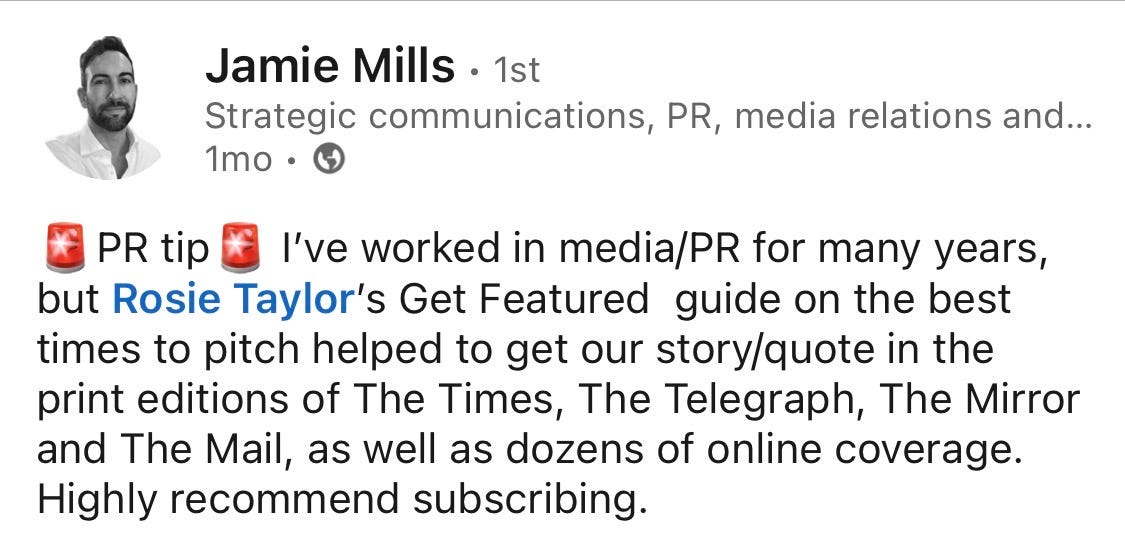
And it really does work. Thanks to Jamie Mills for sharing what happened when he applied the info in the 2025 guide to his pitching strategy:
Who am I?
For those of you who are new here, I’m Rosie Taylor, an award-winning freelance journalist and every Monday I send out this Get Featured newsletter, sharing advice on how to successfully pitch to the UK national media.
As a freelance journalist, I sit on both sides of the pitching “fence”: I receive press releases and PR pitches every day, but I also have to pitch my stories to editors, so I know how hard it can be to get your ideas out there.
This newsletter shares what I’ve learnt about what works, what doesn’t - and why we all need to keep updating our pitching strategies to keep up with the rapidly-evolving media environment.
On that note…
A quick plug for my upcoming webinar!:
The media pitching landscape has changed dramatically in the past 18 months. But that doesn’t mean you can’t still get great national coverage.
Find out what’s changed, why and how to adjust your pitching strategy to maximise your success in 2026 in my webinar: Media Pitching in 2026: What You Need to Know. It’s on at 12.30-1.30pm GMT, Wednesday 14 January 2026. (Don’t worry if you can’t make the live event as all ticket holders will receive a recording to watch back.)
Tickets available now for £22.99 or upgrade to paid today to get £5 off - think of it as getting your first month’s subscription refunded!
Get Featured’s Press Deadlines: The 2026 Guide
OK let’s go…
When you’re pitching, you want to make sure your email lands at a time when the journalist is receptive to new ideas.
Whether that’s when they’re busy compiling their list of news stories for that day or at a quieter time, when they’re planning exclusives for later, pitching at the right time dramatically increases your chances of your pitch getting a “yes”.
But how are you supposed to know when it’s the “right time”?
That’s where this Get Featured’s Press Deadlines: The 2026 Guide is designed to help you.
IMPORTANT NOTE: This guide is designed for anyone pitching news stories and is based on information shared with me by journalists and editors currently working at these publications.
While every effort has been made to ensure accuracy, publications can make changes to their daily editorial schedules without warning. The timings below are subject to change - so use this guide as an aide, not a rulebook.
If you’re aware of any inaccuracies or updates you think I should know about please contact me.
Daily news publications
Daily newspapers have traditionally worked around a morning and afternoon “conference” (a meeting where editors decide which stories to publish). The busiest time for journalists is the hour before a news conference, when they submit story ideas to their editors, and in the early evening, as they write their stories to meet a copy deadline of 5-7pm.
But a lot has changed in recent years. Here’s how the typical day works now, according to journalists working at these publications (in alphabetical order):
Daily Express
The morning conference is 11am and the afternoon conference is 4pm.
Journalists are busiest before morning and after afternoon conference and recommend getting pitches in before 10am if possible.
Best time to pitch: Urgent/breaking/all-round news stories: 8am to 10am.
Longer-term/exclusives: between 11.30am-2.30pm, several days in advance - or at least a few weeks in advance if you want to work on a bigger idea or campaign.
Daily Mail
The news team has a “pre-conference” meeting at 9.30am to discuss the stories for the day/tomorrow’s paper. News editors confirm which of these stories to put on the newslist (the list of stories planned for publication) by 1pm. Late stories can be added to the afternoon news list at 3.45pm but this is usually reserved for big updates on breaking news stories.
Best time to pitch: Urgent/breaking/all-round news stories for tomorrow’s paper: before 9am that day. Longer-term stories (embargoed for a later date) or exclusive stories: when it’s quieter between 11am-12.30pm.
NOTE: The Mail Online newsdesk is run separately. Pitch stories for today as early as possible when shifts start, e.g. 7-7.30am.
Daily Mirror
Morning conference is at 10am, with journalists expected to file their listlines by 9.30am. There is currently no formal afternoon news conference, although major breaking stories may be added later.
Pitch breaking stories as early as possible to secure a place on the morning news list - Mirror journalists say sending a quick note to let them know an important story is coming later that day is helpful for planning, even if you can’t send the full release immediately.
Best time to pitch: Urgent/breaking/all-round news stories: 7.30-9am, the earlier the better.
Longer-term/exclusives: between 11.30am-2pm, at least a few days in advance.
The Guardian
Conferences are held at around 9am, 12noon and 4.45pm, with journalists busiest in the hour ahead of the morning conferences, and while filing stories in the late afternoon.
The global online team at the Guardian work shifts to ensure the site is updated 24/7. The UK digital team usually works 7am to 7pm, while the US team is typically contactable from around 12pm to 12am UK time.
Best time to pitch: Urgent/breaking/all-round news stories: by 8.30am.
Longer-term/exclusives: between 12.30pm-2.30pm, at least a few days in advance.
The i
The I holds an early conference for ideas at 8.30am and then a full editors’ conference at 10.30am. An additional meeting to plan the day’s headlines and stories for upcoming days is held at 3pm.
Best time to pitch: Urgent/breaking/all-round news stories: get your pitch in before 8am to have the best chance of it featuring in the ideas conference, but news stories can be added to the list for the day up to 10am.
Longer-term/exclusives: between 11am-2pm - send so the ideas are fresh in editors’ minds when they go to the 3pm planning meeting.
The Independent
There is a conference at around 8.30am but the main morning conference is at 10.30am - make sure you send any stories for today in ahead of this. Or even better, pitch in the afternoon of the day before. While there is an additional meeting to discuss the splash (front-page story) of the digital newspaper at 4.30pm, only major stories are likely to be added then.
Best time to pitch: Urgent/breaking/all-round news stories: directly to section editors before 8am or to news journalists by 9-10am.
Longer-term/exclusives: between 12-3pm.
The Telegraph
Conferences are now held at 9am (where the “top story” for the day’s website is usually chosen), 12pm and 4pm, focused on the day’s website and tomorrow’s paper. Major breaking stories can be added to a “late list” for a 5.30pm conference.
Journalists are very busy ahead of the main morning conference (they file their listlines by 11am) and after 3pm, when they write their stories.
Best time to pitch: Urgent/breaking/all-round news stories for today’s website/tomorrow’s paper: Get in before 8am to bag a “top story” slot online for that day, but even better if you can send it under embargo a day or two before.
Longer-term/exclusives: send between 11.30am-2.30pm at least a few days before. For the weekend papers, pitch by Wednesday AM at the latest.
The Times
Conferences are now held at 8am, 10.30am and 3pm and are focused on choosing which stories to highlight on digital platforms. The newspaper’s splash (main front-page story) is chosen at the 3pm conference, unless a very major story breaks later.
Journalists have to file their listlines by 10am. They are busiest 9-10am, as well as when filing copy later in the late afternoon, so avoid sending non-urgent messages at that time.
Best time to pitch: Urgent/breaking/all-round news stories for today’s website/tomorrow’s paper: before 9am that day.
Longer-term/exclusives: between 11am-1pm at least a few days before. To feature in the Saturday edition, pitch your exclusives by the Tuesday of that week.
Sunday news publications
Regardless of their individual conference times during each day, most Sunday newspapers follow the same weekly pattern when choosing which stories to put in the paper.
You don’t need to worry too much about the daily routine - it’s key to follow this weekly schedule instead when pitching news stories.
Here is an example, based on the current schedule for The Sunday Times:
Monday: Most news reporters are off work, avoid emailing on this day.
Tuesday: News reporters pitch their news stories for the week to the newsdesk.
Wednesday: Reporters continue to work on stories and flag up any new ideas/updates.
Thursday: Editors hold main news conference to decide most of the content for Sunday’s paper. Only major breaking news stories are likely to be parachuted into the paper after this point.
Friday: Deadline for news journalists to file their stories.
Saturday: Any urgent breaking news stories and last-minute updates are added.
Sunday: Paper published. News reporters off work.
Best time to pitch a news story to a Sunday paper: On a Tuesday or Wednesday - but ideally at least a week in advance (i.e. the Tuesday the week before the story is planned to run on a Sunday), preferably 2-3 weeks ahead.
Anything I’ve missed?
If you spot any inaccuracies or you would like to share details about a publication not listed here, please get in touch.
Ready to get pitching? Make sure your email catches the attention of the right journalist using these Get Featured guides:


This is such a good guide, thanks! Can we still buy the recording of your webinar? Ta.